Introduction
Maslow’s hierarchy of needs is a very important framework in psychology to understand and predict human behavior. It states that humans go through different stages throughout their lives. Each stage has various needs baked into it. Before moving onto next stage one must fulfill the needs of the current stage. It's kind of like a ladder and is often depicted with a pyramid diagram.
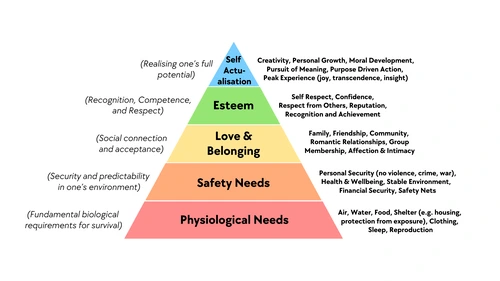
There are five stages of human needs as described by maslow:
Physiological
Safety
Belonging or emotional
Esteem
Self-actualization
These needs are physiological, but they also closely represent economic structures in society as one might see. Before going into how we can use this framework to our advantage lets briefly discuss each stage.
Physiological needs are the basic needs for human existence. These must be fulfilled before one can focus on anything else. These include things like food, water, air not being cold or in pain. To understand this think of someone with all the problems and motivation one might have and a stone is stuck in their shoe. They would not be able to even think about anything else before removing the stone and getting rid of the pain.
After that there comes safety needs. And to my experience this is where mist people are stuck. At this stage one’s physiological needs are met, and he thinks about keeping it that way. The priority at this stage is to make sure they would not be hungry, cold, or no one would cause harm to them.
After that there comes the need for love and belonging. At this stage, people tend to look for meaningful relationships. They need love and warmth. They find someone to feel comfortable around. Humans are social beings after all.
The next stage in Maslow's hierarchy is esteem. Once felt loved one wants to be felt respected. Here are where status and ranks become important. People want to know that they are worth something. Thet start to compare themselves with others. They want to look good in the eyes of others and themselves as well.
The final stage of Maslow's hierarchy is self-actualization. At this stage, one wants to test his potential. He wants to turn into the best version of himself. He wants to be the most he can be. Here people care about leaving a mark and making the world a better place.
How to use the pyramid of needs?
This framework, if used correctly, can be a wonderful way to fulfill the basic purpose of psychology. That is to understand and predict human behavior and adjust our actions to it. It can help us get an idea of what someone's motivations and priorities can be. By getting an idea of what stage of pyramid someone stands at, we can present ourselves in a way that they would understand and care about.
Consider someone hungry for two days, you would not try to tell him about global warming, and he would not care. Or consider someone like Elon musk who is trying to put man on mars, do you think he would care that by investing $500 aa month you can retire in 25 years. When we try to explain something to someone and we don’t get the response we like, we often think that person is too dumb or too arrogant, but truth might be that they stand at a different stage with different goals and motivations.
The key to getting the best out of the framework is to understand what stage someone stands at by considering all the information available about them. For that, you can consider all the information you have available regarding that person. You can also try to infer that from the topics they show interest in, examples they quote or events they discuss. Once you have figured out the stage, you can present your point in a way they care about. If someone is at stage, one focuses on their basic needs. Similarly, for someone at stage three try to build meaningful connection. Show them love and affection. For those at the final stage of hierarchy, talk to them about the greater meaning of life. How can one touch their true potential. By doing so you would have a greater impact than by just going and saying your mind out.
Problems with the pyramid of needs.
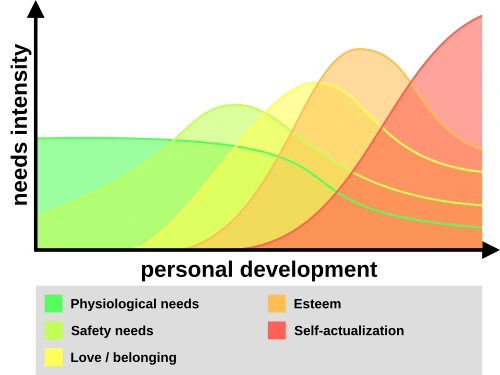
Like everything else in the world, this framework is not without limitation. So, it's better to keep them in mind before relying on it. Firstly, the pyramid view is a bit misleading. In actuality, life is not divided into discreet segments. People's motivations can span across multiple stages at the same time, making the situation a bit tricky. A better representation of stages would be something like this.
Also, the framework is also not fool proof. There are several phenomena taking place simultaneously. The human brain is a hard thing to understand after all. One at a certain stage might not act the way predicted by the hierarchy of needs, and the cause may be any one of a million. Think of this framework as one of the better tools to understand others, but it should not be the only tool.